Picture six friends on a boat that “sleeps ten.” By Wednesday two of them are waiting for the same bathroom, one has claimed the saloon table that folds into a bed, and the towels are still wet. The listing wasn’t lying. It just counted every bunk. A berth isn’t a bedroom, a long boat isn’t a comfortable one, and the biggest hull on the page is hardly ever the right pick. Choosing a catamaran charter is about fit: who’s coming, how you like to spend the day, where you plan to go. The same applies whether it’s Sicily or somewhere else. What follows covers layouts, capacity, costs and the skipper side of things, in the order that tends to matter.
Count heads first. Headline capacity includes the folding table and the small forward cabins meant for crew, so the number of guests who’ll sleep well is lower than the number in the ad. Look closely at the catamaran cabins. How many doubles? How private are they? Does each have a bathroom, or do two cabins share? Many charter boats offer four double cabins with either two or four bathrooms, and even boats of a similar catamaran size can be laid out differently. The plan tells you more than the length does.
Families and couples often want a hull each. Friends care about bathrooms. If a skipper’s coming along, ask where they sleep. A small separate berth leaves every one of the guest yacht cabins free. A berth taken out of a guest cabin takes space from everyone.
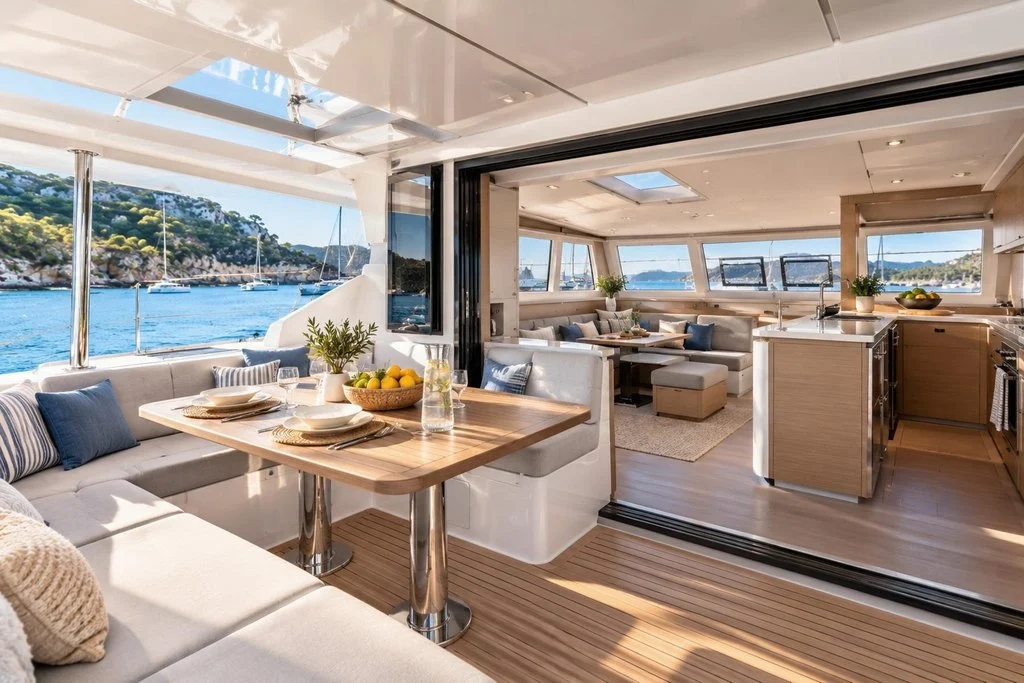
How a week feels depends on where you live on the boat. The cockpit for breakfast and long dinners. The saloon when it rains or the sun’s too much. The galley, for whoever draws the cooking. On most charter catamarans the saloon and galley are on one level with the cockpit just outside, which keeps the cook in the conversation, though some boats swap the galley and dining area and you’ll notice at the first meal. Look at the shade over the cockpit, how many people the table really seats, where the luggage and wet gear go, and whether the cabins sit away from the social spaces.
Somebody after quiet mornings on deck needs something else than a group that lives in the cockpit. That’s the catamaran experience you’re really choosing, and a listing for a catamaran charter doesn’t say so.
Features follow from that. Families want shaded space and wide, level decks, which help with small children and less mobile guests. Friends need a cockpit that works for the group and cabins spread across both hulls. A swimming week rewards easy water access and a good platform to step off. On longer passages you’ll want comfortable seats, shelter from sun and wind, and a saloon people don’t mind sitting in. None of it guarantees comfort in every sea. The skipper will still shape the day around the conditions, and the best catamaran for you is the one that fits your week, not whichever sits at the top of a ranking.
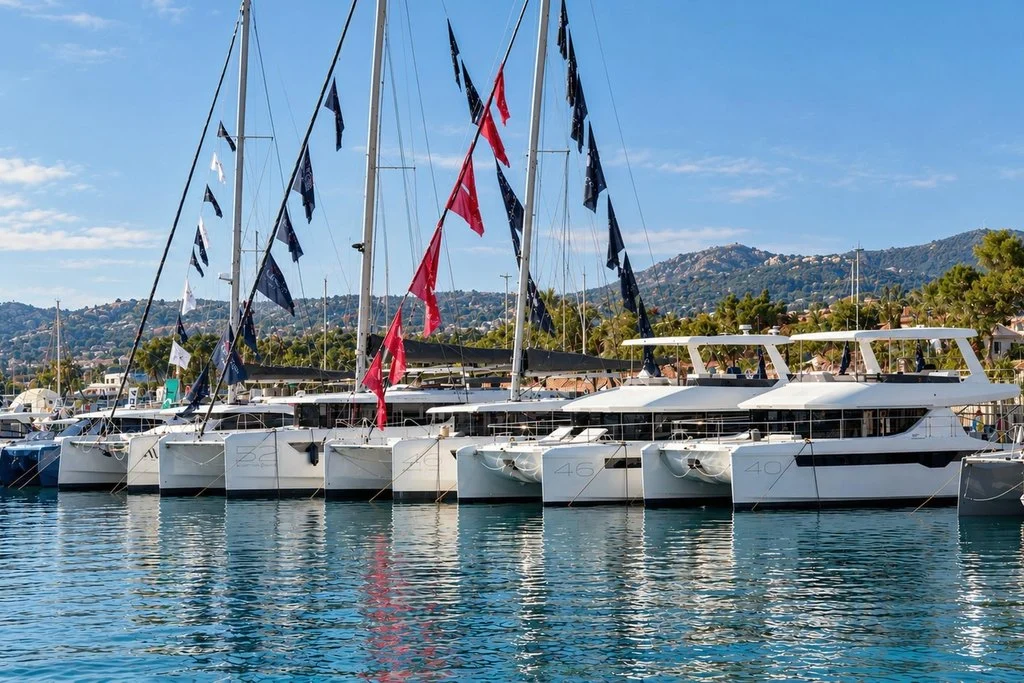
Not every catamaran does the same job. Among the types of catamaran in the catamarans for charter you’ll find, one split is sail versus motor, another is fleet layout versus owner layout. Charter boats usually give each corner a cabin and bathroom so everyone gets equal space, and owner versions give a whole hull to one suite.
Catamaran sailing feels upright and steady, with very little heel, which many first-timers like. Cats tack less nimbly, though, and can slap into short seas. Compared with a monohull, you get more living space for the length, a shallower draft and a wider beam that needs more room in a marina. Call it catamaran vs monohull or catamaran vs sailboat, and nobody wins outright. A monohull sails closer to the wind and usually costs less to charter and berth.
Two listings for the same boat can describe different weeks. Before comparing any catamaran rental, ask what the base price covers and what it leaves out. Is the skipper in it or on top? Who pays for fuel, provisions and harbour fees, which can run higher for wide multihulls? What about final cleaning, local taxes and linen? How does the security deposit work, and when does it come back? Operators bundle things differently, so line up the same inclusions before you pick a number. Two quotes that look close can differ by a skipper, a week of fuel and a final clean. Our guide to the real cost of a sailing holiday goes through the categories. And the boat that looks cheapest can end up dearer once the extras arrive.
Picking the boat is half the job on a skippered holiday. The other half is the arrangement around it: where the skipper sleeps, how the fee works, what they handle and what’s left to guests. A boat rental with skipper usually puts them in charge of navigation and safety, with guests following instructions and helping with lines. Not sure whether you need one? Our with-or-without guide covers that. The same questions apply if you’re looking at a crewed yacht charter Italy offers, although fully crewed boats have different terms. Check the cabin plan works with a skipper aboard, because on some boats their berth takes a guest cabin. Catamarano Skipper curates charter options and points readers to booking platforms and operators, so you can compare boats and terms. It doesn’t own boats or supply skippers.
A few questions are worth asking first. Does the cabin layout suit everyone? Is the bathroom setup fair, including for whoever ends up sharing? Is there room to sit together? Are the included services and extra costs clear? Does the boat fit the harbours and bays you have in mind, and not only the brochure? Do you know what the skipper’s berth and duties are? Get the cabin plan in writing.
The right catamaran is the one whose layout, capacity, facilities and terms suit your group and the week you want. Not the largest in the results. Ask for the plan. Line up the inclusions. Talk through the skipper arrangement before you commit. When you’re ready to compare catamaran charter Italy options, Catamarano Skipper points you to curated skippered multihull choices and guides.
On every sailing boat, somebody is keeping an eye on the wind. The real question for your week is whether that somebody is you. If you plan the route, trim the sails and make the weather calls yourself, the trip is entirely yours. If you hand all of it to a professional, those same hours go to swimming, reading and arguing about lunch. Neither makes the better holiday. It comes down to your experience, your qualifications, who’s coming and what you can spend. Catamarano Skipper is a guide to skippered multihull options, so we’ll treat the choice of a boat with skipper fairly against sailing independently, whichever sailing holiday you have in mind.
Picture the day from a deck chair. Coffee, a swim stop, a late lunch in a harbour you’d never have found alone. A professional boat skipper handles the navigation, the boat handling and the weather decisions, and usually starts with a safety briefing and a walk around the boat. After that you shape the week together. Say what matters to you and the route bends around it, within what the sea allows. Local knowledge comes with the arrangement, from quiet bays to the right harbour restaurant. Your own part is lighter but it’s real. You follow the safety instructions, accept that the skipper has the final say on safe navigation, and expect to help with lines when docking. As the person who signs the agreement, you also remain responsible for payments and for your guests. Don’t expect a cook or a cruise director. A relaxed sailing holiday runs on good communication.
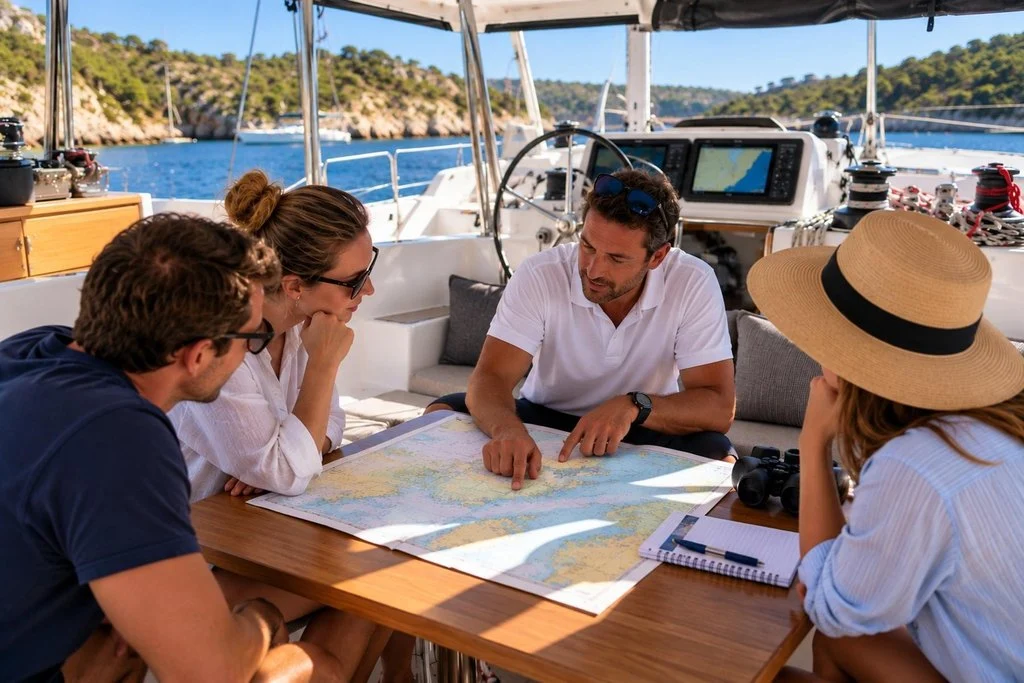
Bareboat means the boat arrives without a hired professional, and the work passes to you. That covers passage planning, manoeuvring in tight marinas, weather decisions and running the crew. In return you get independence, since you choose the route and the pace, inside what’s safe and permitted. A bareboat charter asks you to prove you can handle all of it. Across much of the Mediterranean, operators expect a recognised sailing certificate, such as the International Certificate of Competence or a Day Skipper-level qualification, along with some evidence of recent experience, and Croatia adds a radio certificate on top. Many Caribbean destinations are looser, and a sailing résumé can be enough. So the bareboat charter requirements depend on the boat, the flag, the destination and the operator, and a bareboat charter license by itself doesn’t always meet a company’s experience rules. Get the exact list before you pay a deposit.

Start with who runs the boat. On a skippered yacht charter it’s a professional, and on a bareboat charter it’s the qualified charterer and crew. Planning the day works differently too. With a boat with skipper you talk through stops and the skipper shapes the route around wind and safety, but go bareboat and the plan is yours to build, and yours to defend when it goes wrong.
Experience is the next split. A yacht charter with skipper suits people who can’t operate the vessel, or just don’t want to, while bareboat bookings come with formal competence checks. Then there’s how much independence you want. Bareboat gives you direct control of the sailing. A skipper brings professional handling and opens the week up to more people. Put simply, bareboat trades ease for control, and a skipper trades some control for ease. One practical point: the skipper counts as crew on the official list, so they take a place in the boat’s capacity, usually in a cabin of their own.
Neither option is absolute. A skipper can’t promise every stop you fancy, and bareboat crews meet the same weather, safety rules and local restrictions.
Usually the skipper adds a line to the bill, though that’s rarely the whole story. A boat rental with skipper may show the fee separately or fold it into a package, so compare the full booking and not the headline price of the boat. Ask about the skipper’s food, which guests normally cover, and about where they sleep. Then keep in mind that fuel, provisions, marinas and final cleaning apply whether or not a skipper is aboard. That’s why bareboat isn’t automatically the cheaper road once you count the responsibility that comes with it. Rates move with the offer, destination and dates, so ask for a clear total on any skippered charter before you compare. Line up the same dates, the same boat and the same inclusions first, or the gap between two quotes mostly measures what each one leaves out. Our cost guide breaks down each category.
A skipper probably suits you if you’d like to enjoy the week without being in charge of navigation, or if you don’t hold the qualification a bareboat booking demands. It also fits a group that would rather spend its energy on the destination, and anyone who wants professional hands on the boat but still a say in the plans. Travelling with children is another case. Their safety stays your job either way, but you may like someone else carrying the navigation. And if you’re simply curious about sailing, many skippers are glad to involve guests who want to learn, though formal training isn’t a given.
A bareboat charter may suit you instead if you hold the right qualification and meet the local rules, and you enjoy planning passages and carrying the responsibility. Everyone aboard should also be comfortable with what that responsibility involves.
Either way, no option guarantees a particular itinerary. Weather, local rules and safety calls reshape every week at sea.
Before you rent a boat with skipper, or commit to sailing yourself, put a few things to the operator. Is the skipper included in the advertised price? Who covers the skipper’s meals, and where do they sleep? Ask what qualifications and documents a bareboat booking requires, and what the charter price includes. Find out who makes route and safety decisions when conditions change, and whether you can ask for a different skipper if the match isn’t right. And don’t skip the deposit, payment and cancellation terms. Written answers beat verbal ones, so keep them with your booking.
The right choice starts with the week you want and the requirements you can honestly meet. If that week means swimming, slow harbours and someone else watching the wind, a boat with skipper may be exactly right. Catamarano Skipper helps you discover and compare skippered multihull options, so you can shape your sailing holiday around what you want to do, not what you have to.